
Part Two: Between Myths and Memory — Why Sacred Storytelling Still Matters
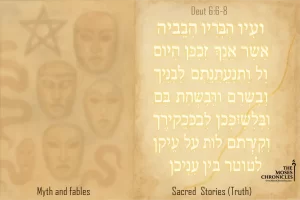
You shall teach them diligently to your children,
and shall talk of them when you sit in your house,
when you walk by the way,
when you lie down,
and when you rise up.
You shall bind them as a sign on your hand,
and they shall be as frontlets between your eyes.
—Deuteronomy 6:6–8
Some stories are meant to entertain.
Others are meant to anchor.
As we pass through an age of instant content, we must remember: not all stories carry the same weight.
There is a difference between a sacred story and a myth.
Between a fable and a testimony.
Between a tale meant to amuse—and one meant to call us back to truth.
What Is a Sacred Story?
A sacred story is rooted in remembrance.
It’s not just told—it’s obeyed, honored, passed down like a birthright.
The Bible is not a book of fairy tales.
It is a book of covenants, confrontations, and promises kept in blood.
And yet, even Christians today are tempted to flatten the stories of Scripture—to treat them like moral fables, or worse, ancient myths disconnected from our modern world.
But the Bible insists otherwise.
These stories were not just meant to be read.
They were meant to be recited, embodied, taught, bound to the hand and head.
Worn like a seal.
Lived like a command.
That’s why The Moses Chronicles exists.
That’s why Selah Publishing House was born.
To guard these sacred rhythms
in a world of noise.
What’s the Difference?
Here’s a brief look at the differences—because it matters how we name a thing.
| Type | Purpose | Source | Tone |
|---|---|---|---|
| Sacred Story | To remember, obey, and preserve truth | Scripture / Testimony | Reverent, slow, weighty |
| Myth | To explain nature or origins | Pagan, symbolic traditions | Imagined, often divine drama |
| Fable | To teach moral lessons | Folk culture (Aesop, etc.) | Clever, short, didactic |
| Old Wives’ Tale | To warn or guide based on superstition | Oral tradition (unverified) | Cautionary, informal |
Myths may hold symbols.
Fables may hold lessons.
But sacred stories hold covenant.
They remind us of who God is.
Who we are.
What He has done.
And what we must not forget.
A Story Worth Binding
If Scripture calls us to tell the stories when we sit… when we rise… when we lie down…
Then storytelling is not a tool.
It’s a command.
A sacred act.
A means of spiritual formation in a distracted age.
That’s why we tell the story of Dinah.
Not as folklore, but as family history.
That’s why we linger in Goshen.
Not to fictionalize the past, but to remember it rightly—in rhythm, in breath, in lament.
Why It Still Matters
Because we are forgetful people.
Because we need more than headlines and highlight reels.
Because truth is not passed down through algorithms.
It is whispered.
Breathed.
Told again at the dinner table.
Remembered in times of loss.
Sacred storytelling is how we keep the covenant alive in the next generation—
not by debate,
but by devotion.
📖 Download 7 Free Chapters (No Sign-Up Needed)
We’re offering seven chapters—three from Prelude, four from Hands That Rock the Cradle—so you can begin the journey yourself.
- ✅ Learn how sacred stories differ from myths and fables
- ✅ Experience the poetic rhythm of biblical fiction firsthand
- ✅ Equip your family to talk of these stories when you rise, and when you lie down
📩 Click here to download your free sample
Learn more about: Prelude or Hands that Rock the Cradle.
International Readers, we’ve made it easier to pay in your local currency. Please visit:
KENYA |
PHILIPPINES |
SOUTH AFRICA |
NIGERIA
About the Author
RR Wekesa is a Christian historical fiction author writing faith-rich novels that follow the ancient paths of Scripture, weaving sacred silence and poetic rhythm into every chapter of The Moses Chronicles.